Why This Guide Matters: Hardened Steel Is Different
If you’ve ever tried to drill through hardened steel with a random old bit and watched sparks fly while the bit either blunted or snapped, you know this: hardened steel behaves like a different planet. It’s tougher, work-hardens, and punishes poor technique. This guide walks you step-by-step through what makes certain carbide drill bits superior for hardened steel — and how to pick, use, and care for them so your next job doesn’t turn into a battle.
Understanding Hardened Steel: What “Hardened” Really Means
“Hardened steel” is shorthand for steels that have been heat-treated to raise hardness — often expressed on the Rockwell scale (e.g., HRC 40–70). The higher the HRC, the harder the material and the more it resists cutting. Hardened steel often includes tool steels and parts that must keep shape under wear. Important takeaway: hardness increases abrasion resistance but also makes conventional HSS drill bits inefficient or useless. Hardened steels can also exhibit surface tensile changes that cause work-hardening — a key challenge while drilling.
Why Carbide? The Material Science Behind the Choice
Carbide — typically tungsten carbide bonded with cobalt — offers a huge advantage: it’s extremely hard and heat resistant. While HSS softens quickly at elevated temperatures, carbide retains cutting edges at much higher temperatures, enabling faster cutting and longer life when machining hardened steels. Carbide’s downside: it's brittle. That’s why geometry, machining setup, and rigidity matter as much as material.
Types of Carbide Drill Bits
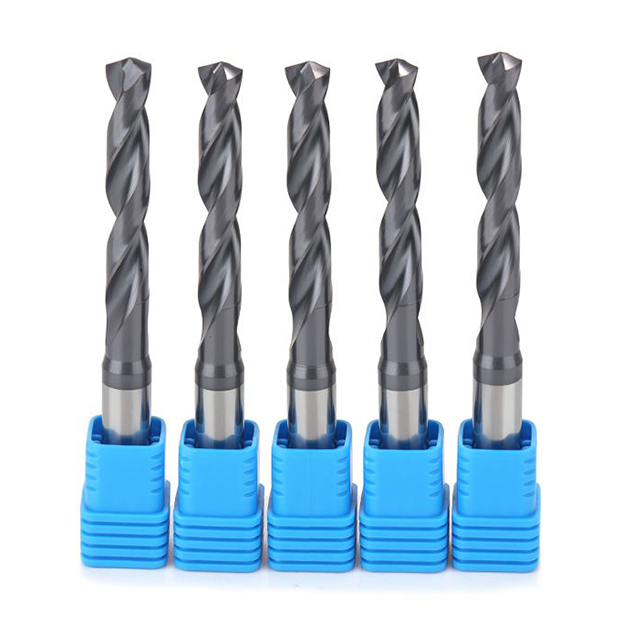
Solid Carbide vs Carbide-Tipped
Solid carbide drills are made entirely of carbide and are best for high-precision, high-speed CNC work. Carbide-tipped drills (carbide insert or brazed tips) combine a steel body with a carbide cutting edge — often more economical for larger hole diameters and situations where some toughness in the shank is desired.
Insert Carbide Drills
Insert drills use replaceable carbide inserts. They’re great for production runs: when the edge dulls, flip/replace the insert instead of buying a new drill. Inserts are tuned for specific materials and can be economical for many-hole jobs on hardened materials.
Micro-Grain vs Nano-Grain Carbide
Micro-grain carbide has relatively larger carbide crystals and offers toughness; nano-grain is finer and harder, yielding better wear resistance and longer life at high speeds. For very abrasive, highly hardened steel, modern nano-grain carbides often outperform older micro-grain grades.
Coatings and Treatments That Improve Performance
TiN, TiAlN, AlTiN, DLC — What They Do
Coatings reduce friction, increase heat resistance, and extend tool life. TiN (titanium nitride) is the classic gold coating — it lowers friction. TiAlN and AlTiN add aluminum, improving oxidation resistance and working well for high-temperature cutting. DLC (diamond-like carbon) and PVD diamond coatings can be exceptional with abrasive hardened steels. For drilling hardened steel, AlTiN or PVD diamond-coated carbide is often preferred.
Post-grind and Cryogenic Treatments
Some manufacturers use cryogenic treatments and optimized post-grind processes to relieve internal stresses and boost wear resistance. These aren’t magic fixes — but they can extend life and reduce chipping, especially with brittle carbide grades.
Geometry Matters: Point Angle, Flutes, Web and Margin
Point Angles for Hardened Steel
Typical point angles range from 118° to 135° for general steels. For hardened steels, slightly larger point angles (135° or more) reduce chipping and give better centering and stability; split points or parabolic points can reduce walking. The point angle affects entry behavior and the load on the cutting lip — a shallow angle can dig in; a steeper angle tends to slice better in hard materials.
Flute Design & Chip Evacuation
Carbide drills for hardened steel usually have fewer flutes or special parabolic flutes to help evacuate small, powdery chips that form when machining hard metal. Good chip evacuation prevents re-cutting and heat buildup. For deep holes, flutes and chipbreaker designs are mission-critical.
Web Thickness and Bridging
A thick web adds strength but reduces chip space; too thick and you get poor chip flow and excessive torque. Many carbide drills for hardened steel use a reduced web design to balance strength and chip clearance. Margin design (whether the drill has a full margin or partial) also impacts hole finish and friction.
How to Choose the Best Carbide Drill Bit for Your Application
Material Hardness & Rockwell Scale
Ask: what is the HRC of your workpiece? For steels under HRC 40, some cobalt HSS or carbide-tipped tools might work; above HRC 40–45, solid carbide or specialized carbide-tipped tools become necessary. If the job is tool steel or hardened shafts above HRC 55, you’ll want premium carbide with appropriate coatings.
Hole Size, Depth, Tolerance Needs
Shallow holes (<3× diameter) are easier than deep holes (>5–8× diameter). For deep holes in hardened steel, you’ll likely need specialized deep-hole drills, gun drills, or peck-drilling strategies and excellent coolant. Tolerances matter — for tight bores, solid carbide drills ground to size or reamed holes are preferred.
Machine Type: Hand Drill vs Drill Press vs CNC
Carbide is brittle — it doesn’t like misalignment or vibration. If you’re using a handheld drill, chances of chatter and breakage are high. Use a drill press or CNC with good rigidity and a reliable chuck/spindle for best results. CNC also lets you control peck cycles, dwell times, and optimized feeds/speeds precisely.
Speeds, Feeds, and Drilling Techniques
Recommended Cutting Speeds and Feeds (General Rules)
Carbide allows higher cutting speeds than HSS. Rough rule: use lower RPMs for larger diameters and hardened steel, but maintain sufficient feed per revolution to keep the carbide cutting (avoid rubbing). Example (very general): for small-diameter solid carbide drills in hard steel, cutting speeds might be 20–80 SFM (surface feet per minute) depending on hardness and coating; always consult manufacturer charts. The crucial point: increase feed to avoid rubbing; decrease RPM if you see excessive heat or burning.
Peck Drilling, Pilot Holes, and Peck Depths
Peck drilling is your friend when cutting hardened steel — it helps clear chips and control heat. Use pilot holes for large diameters: drill a smaller pilot through first, then step up. Peck depth should be tailored: for example, pecks of 2–3× the drill diameter can work but may need adjusting for chip shape and evacuation. Always retract enough to clear chips.
Coolant vs Dry Drilling
Coolant reduces heat and helps evacuation. When drilling very hard steels, use a flood coolant, high-pressure coolant, or through-tool coolant if available. Dry drilling can work with advanced coatings like PVD diamond for short holes, but coolant generally extends tool life and improves hole quality.
Common Problems and How to Fix Them
Bit Breakage
Cause: chatter, misalignment, too much feed or too aggressive pecking, or brittle carbide hitting a hard inclusion. Fixes: increase machine rigidity, reduce runout, slow spindle or increase feed to maintain cutting action, and ensure proper centering (use a starter or pilot). Use compressed air or coolant to clear chips.
Workpiece Burning or Hardening
If the workpiece is overheating and work-hardening ahead of the bit, the bit will blunten quickly. Use proper coolant, lower RPM, and higher feed per rev to maintain a cutting action. Using the right coating (AlTiN/dia) also helps maintain cutting edges at higher temperatures.
Poor Hole Quality and Burrs
Bad finish often comes from misalignment, dull bits, or poor chip control. Use correct geometry, peck cycles, and deburring passes. Consider finishing with a carbide reamer if tolerance and surface finish are critical.
Maintenance: Regrinding, Sharpening, and When to Replace
Carbide can be reground by specialty tool shops, but every grind shortens life and changes geometry. For solid carbide, regrinds must be precision — small mistakes increase brittleness and reduce concentricity. Insert-style drills are easier: swap inserts. Replace when wear reduces performance, when cracks appear, or when repeated regrounds would compromise accuracy.
Comparing Carbide to Other Options (Cobalt, HSS) — Pros & Cons
Carbide pros: hardness, speed, wear resistance, excellent for hardened steels. Cons: brittle, more expensive, needs rigid setup. Cobalt HSS pros: tougher, less brittle, cheaper — but loses hardness at elevated temps and wears fast on hardened steel. For high-volume, high-hardness work, carbide usually wins. For occasional drilling where shock is likely, cobalt HSS might be safer.
Best Practices for Storage and Handling
Store carbide bits in individual sleeves or foam trays to prevent chipping. Avoid dropping them. Keep them dry and labeled. For coated tools, avoid touching cutting edges with bare hands — oils can interact with coatings over long periods.
Top Use Cases & Case Studies (Practical Examples)
Automotive shaft repair: Drilling hardened axle shafts (HRC 55–60) — solid carbide with AlTiN coating, pilot hole, CNC peck cycle, through-spindle coolant. Result: cleaner holes, longer bit life compared to HSS.
Tool & die shop: Drilling hardened tool steels — insert carbide drills allow fast index changes and close tolerances.
Aerospace small-bore holes: Micro-grain solid carbide drills with diamond-like coatings for abrasive, high-hardness alloys.
Checklist: Buying Guide — What to Look For
Material grade (solid carbide vs carbide-tipped)
Carbide grain size (micro vs nano)
Coating type (AlTiN, PVD diamond, DLC)
Geometry specifics (point angle, split point, flute style)
Toolholding requirements (shank style, coolant-through)
Manufacturer specification charts (speeds/feeds) and warranty
Availability of regrinding/inserts and cost per hole computation
Frequently Asked Questions (FAQ)
Q: Can I use carbide drill bits in a handheld drill?
A: Technically yes, but it’s risky. Carbide is brittle and needs rigid fixturing. If you must, use slow speed, steady pressure, clamp the workpiece, and expect shorter life. Prefer a drill press or CNC.
Q: Will diamond-coated carbide always outperform AlTiN?
A: Not always. Diamond-like PVD coatings excel on abrasive materials and some hardened steels, but AlTiN can be superior in high-temperature oxidation resistance. Choose based on the specific steel and machining parameters.
Q: How do I know when a carbide bit is dull?
A: Increased heat, poor finish, burrs, increased required feed force, or a different sound during cutting. Inspect for chipping or edge rounding.
Conclusion — Final Recommendations and Quick Reference
If you’re drilling hardened steel frequently, invest in high-quality solid carbide or carbide-insert drills with appropriate coatings (AlTiN or PVD diamond) and use a rigid machine with coolant and peck cycles. Match point angle and flute design to hole depth and diameter. Remember: carbide buys you speed and wear life, but it demands a precise, rigid setup. Spend a little more on the right tool and machine setup up front — it’ll pay back in fewer broken bits and better hole quality.
Appendix: Quick Reference Table (Speeds/Feeds & Angles)
Note: these are general starting guidelines — always consult tool maker charts for exact values.
Point Angle: 135°–140° for hardened steel (helps reduce chipping)
Coatings: AlTiN or PVD diamond for HRC 45+ steels
Coolant: Flood or through-tool coolant preferred; air blast for shallow, coated applications
Peck Depths: 2–3× diameter for standard drilling; use smaller pecks for powdery chips
Feed per Rev (FPR): Increase feed slightly compared to HSS — maintain cutting action (exact numbers depend on diameter & machine)
Rigidity: Use collets or shrink-fit holders for best runout control


